



Scientific Advisory Committee.
Every dollar Sky awards is directed by scientists, not by us. Nine physicians, researchers and staff run a structured, multi-phase review built for fairness — and for finding the work most likely to matter.
How the review works
External reviewers are assigned so every submission receives multiple independent evaluations. No reviewer may assess a proposal from their own institution.
The committee meets to discuss top-ranked proposals and narrows six leading candidates down to three finalists.
A detailed summary of the review process and the finalist projects is prepared by the SAC liaison for the Governing Board.
Sky Foundation's Governing Board makes the final funding decisions on the finalists put forward.
Any SAC member who applies for a grant is fully recused from every discussion and evaluation, and reviewers never see the applicant's institution.
The committee

Dr. Crawford oversees the entire scientific review process — coordinating external reviewers, leading the SAC’s deliberations, and shaping the research priorities that advance Sky’s work in early detection.
Read the full bio →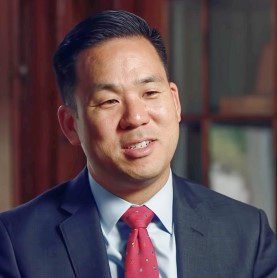
A board-certified surgeon and fellowship-trained surgical oncologist, Dr. Kwon brings the operating room’s perspective to grant review — and leads multidisciplinary teams built around precision medicine and complex cancer care.
Read the full bio →
Dr. Azmi’s laboratory works on drug discovery and translational therapeutics for pancreatic ductal adenocarcinoma and pancreatic neuroendocrine tumors — work that helped bring a first-in-class drug to FDA approval.
Read the full bio →
A cancer biologist whose laboratory work on how KRAS reprograms metabolism has already reached patients — two of her findings launched first-in-human clinical trials.
Read the full bio →
A gastroenterologist and clinician-scientist working on benign and malignant diseases of the pancreas — taking biopsies in clinic and reading them at single-cell resolution in the lab.
Read the full bio →
A cancer immunologist asking the hardest question in the field: why pancreatic tumors resist immunotherapy, and how to break that resistance.
Read the full bio →
Dr. Kugel studies how dysregulated chromatin-modifying enzymes drive hepatopancreatic biliary cancers — and whether those same pathways can be turned into treatment targets.
Read the full bio →
Sammy connects scientific review with organizational strategy — attending every quarterly SAC meeting and final reviewer discussion, and translating complex scientific recommendations into decisions the Board can act on.
Read the full bio →
Taylor runs the grant cycle end to end — the application platform, the reviewer assignments, the conflict-of-interest safeguards, and the anonymity that keeps every review impartial.
Read the full bio →The proposals they chose.
A number of scientists have received a Sky seed grant, many, on this committee's recommendation. See what each of them is working on.
Scientific Advisory Committee.
Every dollar Sky awards is directed by scientists, not by us. Nine physicians, researchers and staff run a structured, multi-phase review built for fairness — and for finding the work most likely to matter.
How the review works
External reviewers are assigned so every submission receives multiple independent evaluations. No reviewer may assess a proposal from their own institution.
The committee meets to discuss top-ranked proposals and narrows six leading candidates down to three finalists.
A detailed summary of the review process and the finalist projects is prepared by the SAC liaison for the Governing Board.
Sky Foundation's Governing Board makes the final funding decisions on the finalists put forward.
Any SAC member who applies for a grant is fully recused from every discussion and evaluation, and reviewers never see the applicant's institution.
The committee
Dr. Crawford oversees the entire scientific review process — coordinating external reviewers, leading the SAC’s deliberations, and shaping the research priorities that advance Sky’s work in early detection.
A board-certified surgeon and fellowship-trained surgical oncologist, Dr. Kwon brings the operating room’s perspective to grant review — and leads multidisciplinary teams built around precision medicine and complex cancer care.
Dr. Azmi’s laboratory works on drug discovery and translational therapeutics for pancreatic ductal adenocarcinoma and pancreatic neuroendocrine tumors — work that helped bring a first-in-class drug to FDA approval.
A cancer biologist whose laboratory work on how KRAS reprograms metabolism has already reached patients — two of her findings launched first-in-human clinical trials.
A gastroenterologist and clinician-scientist working on benign and malignant diseases of the pancreas — taking biopsies in clinic and reading them at single-cell resolution in the lab.
A cancer immunologist asking the hardest question in the field: why pancreatic tumors resist immunotherapy, and how to break that resistance.
Dr. Kugel studies how dysregulated chromatin-modifying enzymes drive hepatopancreatic biliary cancers — and whether those same pathways can be turned into treatment targets.
Sammy connects scientific review with organizational strategy — attending every quarterly SAC meeting and final reviewer discussion, and translating complex scientific recommendations into decisions the Board can act on.
Taylor runs the grant cycle end to end — the application platform, the reviewer assignments, the conflict-of-interest safeguards, and the anonymity that keeps every review impartial.
A number of scientists have received a Sky seed grant, many, on this committee's recommendation. See what each of them is working on.
Meet the researchers →